An analysis of proposed Bill 2026-14 in the October 8 agenda packet. This describes the proposal, not a confirmed final vote.
Nye County’s proposed data-center rules offer developers something valuable: a clear path to approval, permits that survive a sale, and a way to make some changes without another board hearing.
Residents deserve equally clear protection for their water, power, safety, health, and tax dollars.
The proposed bill and amendments include useful safeguards. They require studies, a public hearing, limits on noise, and findings that project costs will not be shifted to residents.
Several provisions weaken public oversight or leave important questions unanswered. Once approval is granted, fixing those gaps could become harder.
The time to demand firm protections is before the county signs away bargaining power.
The Basin 162 ban still matters
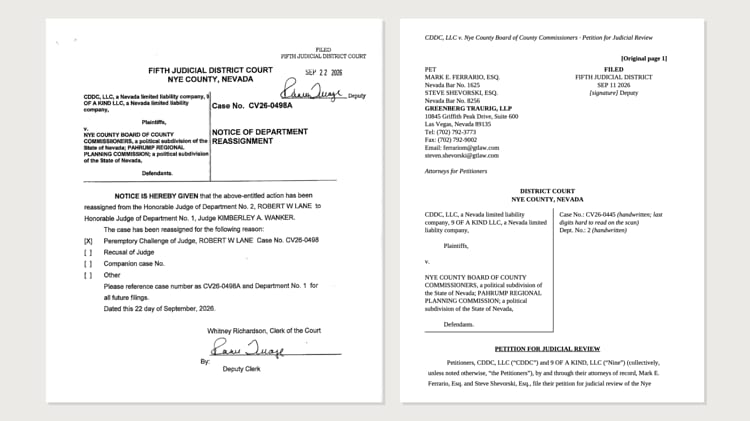
The county adopted Ordinance 631, the separate data-center ban covering Basin 162. It took effect September 7, 2026. nyecountynv.gov
The new permit bill should not be treated as permission to ignore that ban. Being inside the Pahrump Regional Planning District does not, by itself, create an exception.
The county should say this plainly in the final law: No permit, planning approval, development agreement, or later expansion can override the Basin 162 ban.
Leaving that relationship unclear gives lawyers something to argue over and gives the county another possible legal bill.
What developers gain and residents could lose
Under the proposal, a permit follows the land. The facility or company controlling it can be sold without another BOCC approval. The new owner must provide notice and take on the permit’s duties.
That preserves obligations. It also means residents do not automatically get another approval hearing when control changes hands.
Developers get five years to start construction, with extensions possible by agreement. The bill sets no clear limit on the number of extensions.
It also requires a development agreement. Under Nevada law, NRS 278.0201, these agreements can preserve certain land-use rules in place when the agreement is signed. Later county action generally cannot prevent the development promised in the agreement. That can make future changes harder, although it does not erase every safety law. PLANNING AND ZONING
Residents keep their rights to speak and seek court review but they could lose practical chances to influence a project as it changes.
A right to complain after approval is weaker than a meaningful chance to shape the approval itself.
“Only 10%” can become a very large project
The developer’s Manse Technology Campus website describes a proposed campus of about 900 acres south of Pahrump along State Route 160. Manse Technology Campus
Use that size to understand the bill’s expansion language.
The draft allows qualifying increases of 10% or less in building area or project acreage to receive staff approval. Larger changes require BOCC approval.
It does not clearly say that all increases must be added together and measured against the original approved size.
If each increase were measured against the newly enlarged acreage, the numbers would look like this:
Hypothetical step | Project acreage |
|---|---|
Original project | 900 |
First 10% increase | 990 |
Second 10% increase | 1,089 |
Third 10% increase | About 1,198 |
Twelfth 10% increase | About 2,825 |
Three increases would add almost 298 acres. Twelve would bring the acreage to more than three times its starting size.
This is a possible argument created by unclear wording, not an automatic right to triple a facility. Staff approval also requires no increase in off-site impacts and compliance with other conditions. Certain high-voltage equipment changes require board approval. More acreage also does not automatically mean the same increase in water or power use.
The county should close the argument now: measure all growth from the original approval, add every phase together, and set a firm total limit.
Residents should not have to watch a major expansion arrive as a series of “small” changes.
Noise testing does not replace vibration testing
The amendments add limits for certain low-frequency sounds. They do not establish a separate, clear vibration-testing requirement.
Sound moves through the air. Vibration can move through the ground, floors, and walls.
A microphone measures sound pressure. Measuring ground or building movement requires vibration sensors. A sound study alone does not fully measure both problems. Federal noise and vibration guidance treats them separately. FTA
There is medical evidence for taking that difference seriously. A 2017 laboratory study monitored sleep and heart activity in 23 adults. Vibration alone increased brief sleep disruptions and caused short-term heart-rate increases. Combined noise and vibration also disturbed sleep. PMC
That study tested railway vibration, not a data center. It supports requiring proper measurements before officials declare nearby homes protected.
The ordinance should require independent sound and vibration studies before construction, during full operation, and after expansions. Tests should cover nighttime conditions, nearby homes, and equipment running together. Results and correction deadlines should be public.
Generator exceptions need firm boundaries
The revised bill lowers the generator-testing sound limit to 65 decibels on the A-weighted scale.
Generator operation during a power outage or at a utility’s request is exempt from the stated noise limits.
A utility request should not become an open-ended excuse for loud operation.
The county should define qualifying events, require operating logs, and limit non-emergency use. Testing should measure the combined noise and vibration of generators that may run together.
Air permits remain required where applicable. Residents also need a clear process for checking emissions, reporting problems, and enforcing violations. A permit on paper is not proof that equipment performs properly every day.
A data-center fire can become a town emergency
A data center contains more than computers. It can include large electrical systems, backup batteries, generators, and stored fuel.
A real fire shows why preparation matters.
In 2021, a fire destroyed an OVH data-center building in Strasbourg, France, and damaged nearby buildings. The French government investigation identified problems involving fire suppression, water supply, building design, and delays in making electrical systems safe. There were no deaths or injuries. portail.documentation.developpement-durable.gouv.fr
Battery chemistry matters, too. In a separate Arizona battery-storage incident, four specially trained firefighters were severely injured in an explosion. The Fire Safety Research Institute report documents the danger. That incident was not a data-center fire, but it is relevant when evaluating large lithium-ion battery systems. fsri.org
Pahrump lists fire and emergency-response resources. That does not establish whether enough crews, equipment, water, and outside help would be available for a major campus incident while other residents still need emergency care. Pahrump, NV
Before approval, the fire department should assess the entire project, not just its first phase.
The developer should fund needed training, equipment, drills, and ongoing response capacity. Plans should cover battery hazards, fuel spills, electrical shutdowns, fire-water supply, smoke, evacuation, and polluted firefighting runoff.
A town should not discover its emergency limits during the emergency.
Water, secrecy, and cleanup need stronger rules
The water limit contains a serious conflict: it says “one and one-half (.25)” acre-feet per developed acre each year.
Those numbers are six times apart.
The bill already requires power figures in megawatts. It should also require clear totals for every phase and the full completed project, including peak water demand and backup generation.
It bans evaporative cooling but exempts humidifiers. That exception needs a narrow definition and measured water use otherwise it’s a loophole to use water to cool systems disguised as “humidifiers”
The required natural-resource review excludes private-land portions of projects. Private ownership does not stop runoff or wildlife impacts at the fence.
Annual reporting also broadly excludes “operational information.” Trade secrets deserve protection. Water totals, testing results, violations, and public-safety information should remain available to residents.
Finally, the bill excludes data centers from existing chapter provisions containing cleanup and financial-assurance requirements, without providing an equally clear replacement bond.
Require secured cleanup money before construction. It should survive a sale or bankruptcy and cover removal, waste disposal, and site restoration.
Fix the gaps before they become lawsuits
Unclear growth limits, conflicting water numbers, weak monitoring, and uncertain cleanup duties invite disputes.
Residents challenging an approval generally need to pay their own legal costs. If the county must defend its decision, public money and staff time may be spent on the case.
The county can reduce that risk now.
Require a cumulative growth cap, public monitoring, separate vibration testing, full-project water and power totals, a funded emergency plan, and a cleanup bond. Preserve authority to respond to new health and safety evidence.
Developers are asking for rules they can rely on for years. Residents deserve protections that last just as long.