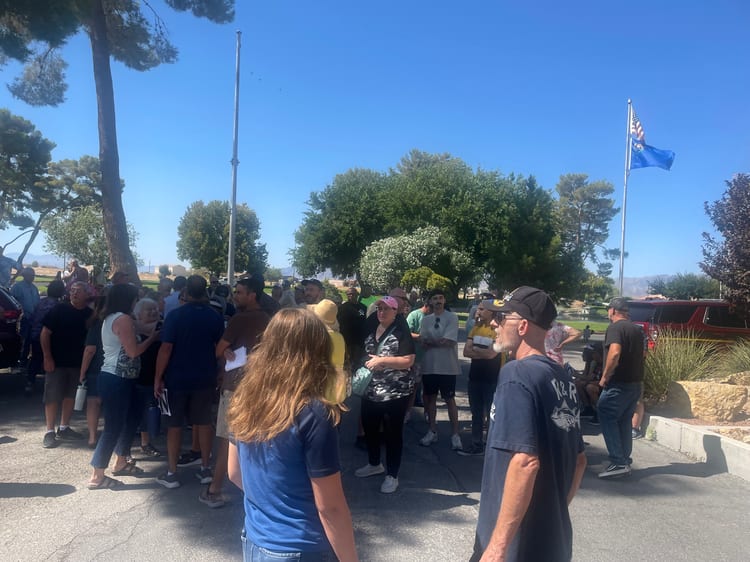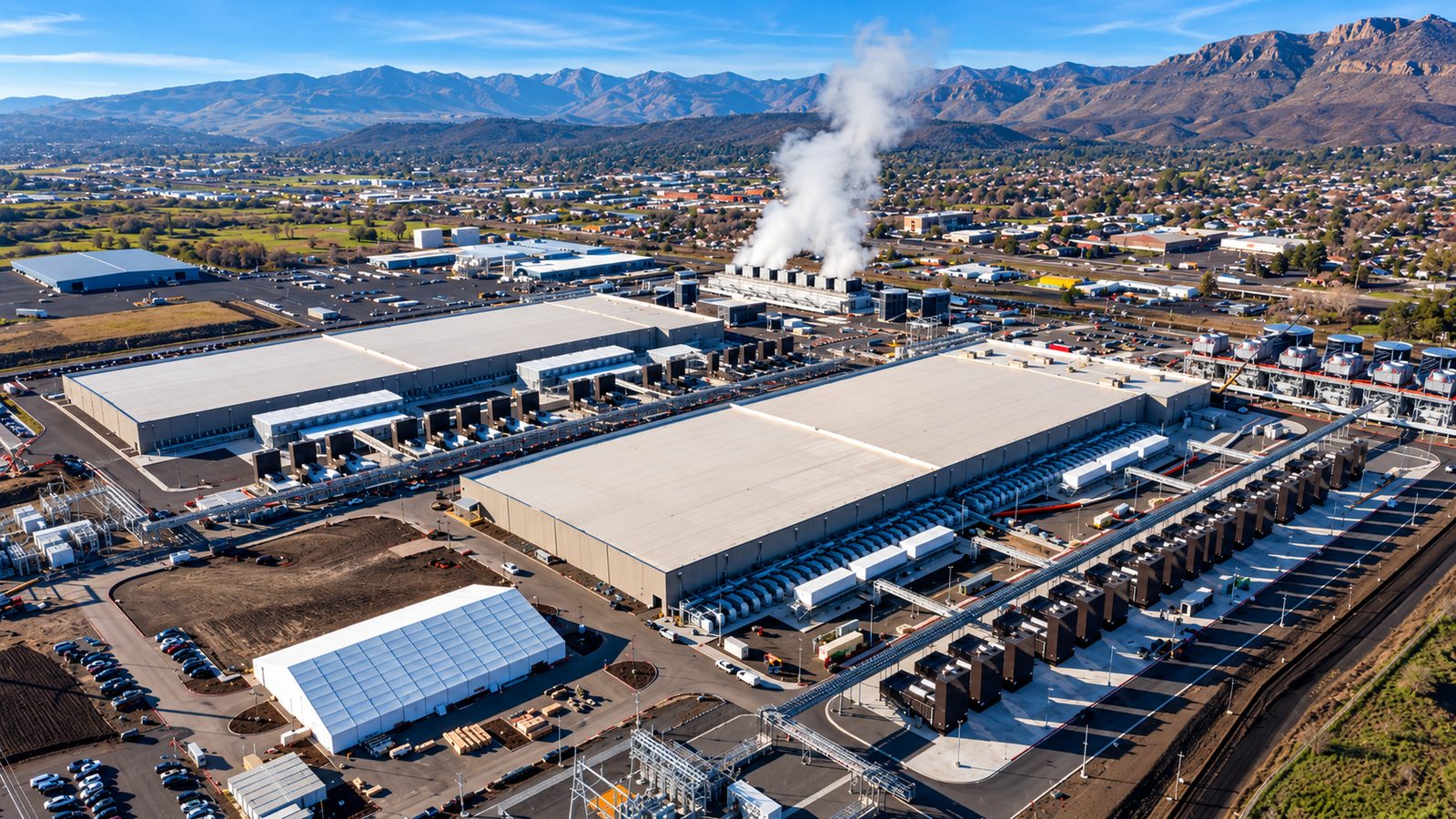
For most people in Pahrump, the national race to build artificial intelligence did not seem like a local issue.
Then came the proposed Manse Technology Campus.
The project website says the proposed campus south of Pahrump would cover about 900 acres and represent $18.4 billion in total capital investment at full buildout. It claims 1,600 construction jobs, 380 permanent jobs and more than $114 million a year in property taxes at full buildout.
Suddenly, a national technology race had arrived in Nye County.
Nye County commissioners have since voted to ban data centers inside Hydrographic Basin 162, which includes Pahrump. But the larger issue is not over. The county is considering how data centers should be regulated elsewhere, and developers across America are searching for places with land, power, fiber and favorable government rules.
So before the next proposal arrives, there is a basic question worth asking:
Who is America building all of these data centers for?
Why Is America Racing to Build Data Centers?
Artificial intelligence requires enormous amounts of computing power.
So do Amazon Web Services, Microsoft Azure, Google Cloud, social media, streaming video, banking, medical records and thousands of other online services.
The federal government now considers large data centers important to America's economic and national security. In March 2026, the White House said large-scale data-center infrastructure should be built in the United States so the country does not become dependent on foreign computing infrastructure.
The demand is real.
Commercial real-estate firm JLL reported that North American data-center demand reached a record 25 gigawatts during just the first half of 2026. About 66 gigawatts were under construction, and 95% of that capacity was already committed to customers.
That has created a modern-day land rush.
But instead of looking for gold, developers are looking for:
cheap or available electricity, large pieces of land, fiber-optic connections, tax advantages and governments willing to approve projects quickly.
Who Is Using All This Computing Power?
The direct customers are not mainly ordinary families or small businesses.
They are mostly very large corporations.
JLL says hyperscalers accounted for 59% of data-center tenant demand in 2026. Hyperscalers are giant technology companies such as Amazon, Microsoft and Google.
Another 11% came from specialized cloud-computing companies called “neoclouds,” while another 7% came from pure AI companies.
Together, those three groups represented about 77% of current tenant demand.
Regular people certainly use what happens inside these buildings. Every Netflix movie, Google search, online purchase or cloud backup has to be processed somewhere.
The companies signing the giant data-center contracts are corporations.
The SEC filing for Digital Realty, one of the world's largest data-center operators, lists customers and industries including Oracle, Meta, JPMorgan Chase, IBM, AT&T, Comcast, LinkedIn and other cloud, communications and financial companies.
Equinix, another major operator, says it has more than 10,500 customers, including more than 2,000 network service providers.
Its customers include cloud companies, telecommunications firms, banks, media companies and large corporations.
So yes, data centers support things all of us use.
The new race for giant campuses is being driven mainly by Big Tech, cloud computing and AI.
America Has More Data Centers Than Anyone
Cloudscene's widely used industry database lists the United States far ahead of every other country.
Country | Listed data centers |
|---|---|
United States | 5,427 |
Germany | 529 |
United Kingdom | 523 |
China | 449 |
Canada | 337 |
France | 322 |
The exact totals vary depending on how a database defines a data center. More importantly, these numbers count buildings, not their size. A giant AI campus can use far more power than dozens of older facilities.
Still, the United States holds an enormous lead. Cloudscene's May 2026 count put about 46% of the world's listed data centers in the United States.
Location creates another question.
Does a data center sitting in America mean Americans own it?
Not necessarily.
American Soil Does Not Always Mean American Money
There is no simple federal database showing what percentage of U.S. data centers are ultimately American-owned, foreign-owned or financed with foreign money.
That matters because data-center ownership can have several layers.
A U.S. company may operate the building. An investment partnership may own the real estate. A pension fund may provide part of the money. Another company may own the servers.
Foreign investment in U.S. technology is generally allowed.
The U.S. Treasury Department says America welcomes foreign investment in the technology industry. The federal Committee on Foreign Investment in the United States, or CFIUS, reviews certain transactions when national-security concerns are involved, but foreign ownership is not simply prohibited.
Foreign capital is already inside American data centers.
Digital Realty's SEC filings provide a remarkably clear example. It formed a partnership with Japanese company Mitsubishi Corporation to develop two data centers in the Dallas area. By 2025, Mitsubishi held an 80% interest, while U.S.-based Digital Realty retained 20%.
Another example came in July 2026. Aligned Data Centers, headquartered in Dallas, was acquired in a deal valuing the company at approximately $40 billion. The buyers included BlackRock's Global Infrastructure Partners and MGX, an investment company based in Abu Dhabi. Aligned has 51 campuses and more than 6.4 gigawatts of operating and planned capacity.
It does mean that “built in America” and “American-owned” are two different claims.
Other Countries Are Asking the Ownership Question Too
Europe is beginning to treat control of computing infrastructure as an issue of sovereignty.
In June 2026, the European Commission proposed the Cloud and AI Development Act. Europe wants to rapidly expand its own data-center capacity, but it is also concerned about dependence on companies outside Europe.
Under the proposed European system, the most sensitive level of government cloud infrastructure could require providers to be owned and controlled from within the European Union, with limited exceptions.
China also controls foreign entry more directly. It recently began pilot programs in Beijing, Shanghai, Hainan and Shenzhen that remove foreign-ownership limits for certain internet data-center services. The fact that China needed special pilot zones shows how controlled foreign participation has traditionally been.
The lesson is not that every country bans foreign money.
They don't.
The lesson is that some governments are asking a question America discusses much less often:
If computing infrastructure becomes critical national infrastructure, does ownership matter?
Governments Are Helping the Race Along
America is not alone in giving the industry incentives.
The United Kingdom is creating AI Growth Zones with faster planning, better access to electricity and, in some areas, electricity-cost reductions beginning in 2027.
France gives qualifying data centers a reduced tax rate on electricity. Germany offers regional investment grants that can apply to large business investments, although its programs are not simply an American-style data-center tax holiday.
The United States has made data-center tax incentives especially common and generous.
The National Conference of State Legislatures says 38 states now offer dedicated data-center tax incentives. All 38 provide sales-tax relief for qualifying equipment. Fourteen also offer electricity-related sales-tax relief, and 11 provide some type of property-tax abatement.
Nevada is one of them.
Nevada can reduce the sales and use tax on qualifying data-center equipment to as little as 2%. It can also cut personal-property taxes by as much as 75% for up to 10 or 20 years.
For a 10-year data-center abatement, Nevada requires at least $25 million in combined capital spending by the applicant and its tenants and only 10 full-time Nevada employees within five years.
For a 20-year abatement, the requirement rises to $100 million and 50 Nevada employees.
That is worth remembering whenever billions of dollars in investment are announced.
What About Bitcoin?
Cryptocurrency mining is often mixed into the data-center debate, but the numbers should not be confused.
A Bitcoin mine can look like a data center and can consume enormous amounts of electricity. Bitcoin mines are generally tracked separately from ordinary cloud and AI data centers.
There is no reliable number showing that a certain percentage of America's data centers are being used for Bitcoin.
The U.S. Energy Information Administration estimated that cryptocurrency mining used somewhere between 0.6% and 2.3% of all U.S. electricity in 2023. That is large, but it is a separate category from most conventional data-center statistics.
Now Bring This Back to Pahrump
This is why the Manse debate was never just about one building project.
Nye County was being asked to consider joining a nationwide race involving billions of dollars, huge electrical loads, powerful corporations and government tax incentives.
There is nothing wrong with asking what Nye County gets in return.
The federal government itself now says giant AI companies should build, bring or buy the new electricity their data centers require and pay for the transmission and other upgrades needed to serve them, rather than leaving those costs with ordinary ratepayers.
Valley Electric CEO Robby Hamlin recently told Nevada lawmakers that protecting the cooperative's roughly 25,000 meters is a priority and that additional costs from data centers and other large loads should be paid by those new loads, not existing members.
That is a good standard.
Nye County can go farther.
Texas recently ordered a major data-center review requiring disclosure of ownership and controlling interests, public incentives, electricity demand, power sources, water use and community impacts.
Britain's AI Growth Zone program requires developers seeking government help to prove they have access to power, provide written information about water availability and produce title documents showing control of the land.
Those are not anti-data-center rules.
They are due diligence.
Before the rest of Nye County gives the next giant data-center project zoning changes, incentives or access to scarce local resources, residents should be able to answer some very simple questions:
Who owns it? Who is financing it? Who will use it? How much power will it require? Who pays for the power infrastructure? What tax breaks will it receive? How many permanent local jobs will remain? And where will the profits ultimately go?
That brings us directly back to Manse and where they may go in Nye County after Pahrump’s Basin 162 data center ban.
While we can identify some of the people and companies behind the proposed Pahrump campus, the most important part of an $18.4 billion project, where all of the money comes from remains much harder to see.
Research and Source Links
Manse Technology Campus: Project website
JLL: North America Data Center Report — Midyear 2026
National Conference of State Legislatures: Subsidizing Servers: How States Are Competing to Attract Data Centers
U.S. Department of Energy: Report on growing data-center electricity demand
U.S. Treasury / CFIUS: Foreign investment in U.S. technology
European Commission: Cloud and AI Development Act and digital sovereignty framework
Nevada GOED: Nevada data-center tax abatements
Texas Governor's Office: 2026 comprehensive data-center audit requirements
U.S. Energy Information Administration: Cryptocurrency mining electricity use
Nevada Current: Nye County's Basin 162 data-center ban