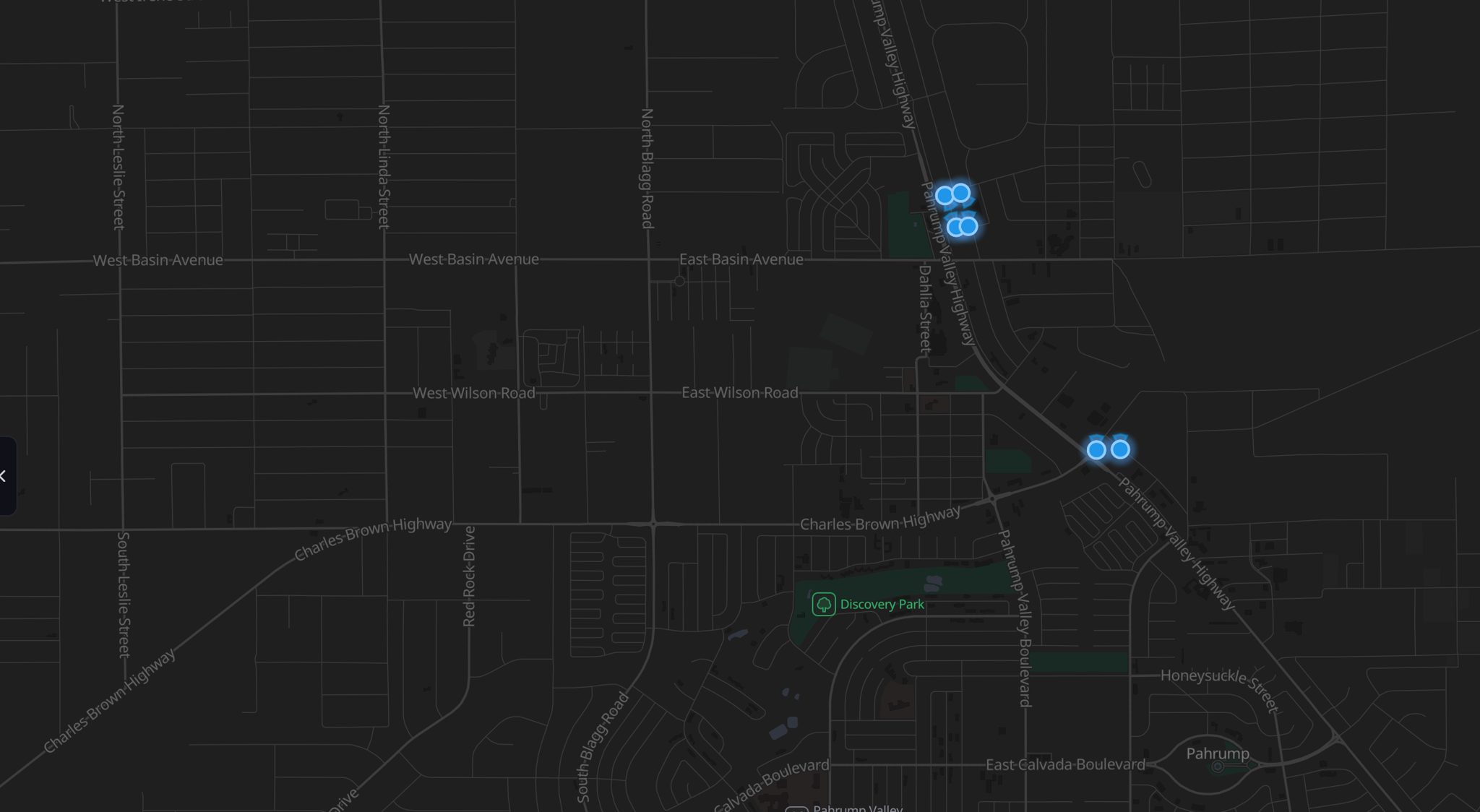
Six Flock cameras are mapped in Pahrump, and every one of them is an automated license plate reader.
Four of them ring the Home Depot at 301 N Highway 160. Each is recorded as a Flock Safety plate reader, and each names its operator: The Home Depot. They were added to the map on 3 March 2026.
The other two sit about a mile south, one on Shoshone Drive and one beside Highway 160, next to the old Gold Town casino, empty since it shut down in May 2026. They carry the same manufacturer and the same equipment type. They name no operator at all. They were added on 8 August 2026, four days before this was written, by a different contributor.
Nobody is required to tell you any of them are there. That is the part worth understanding, so here is what the technology does, and what nobody has said.
How we know
The locations come from DeFlock, a volunteer project that records the whereabouts of surveillance cameras. Its map is the readable version, but the data itself lives in OpenStreetMap, which means you do not have to take our word for it or DeFlock's.
We queried OpenStreetMap directly for every surveillance camera in the Pahrump area. Six came back, all tagged as plate readers, all tagged manufacturer=Flock Safety. The four at the hardware store additionally carry operator=The Home Depot. The two to the south carry no operator field. Each node number above is a permanent link to the record: click one and you see the same tags we did.
That is the strength of this sourcing and also its limit, which we come back to at the end.
What a Flock camera is
Flock Safety sells automated license plate readers, usually solar powered and connected over a mobile network, which is why they appear on poles in parking lots without any construction to speak of.
They are not ordinary security cameras. An ordinary camera records video that somebody has to sit and watch. A plate reader turns every vehicle that passes into a database record: a plate number, a time, and a place, written down automatically, whether or not anyone suspects the driver of anything.
What it captures
Flock's own product page says its cameras capture "vehicle make, model, color, location, and time," and is explicit on one point worth stating plainly: "Flock LPR cameras only capture vehicle data. They do not collect personal information, facial recognition, or anything tied to individuals." That is true, and it is not the whole of the concern.
The Electronic Frontier Foundation has written about what the industry calls a vehicle fingerprint: matching a car not by its plate but by its combination of visible features, so that a vehicle stays identifiable when the plate is dirty, obscured or missing. The EFF's objection is that this sweeps in things that say something about a driver. Damage and rust mark out people who cannot afford repairs. Bumper stickers and decals advertise politics and religion.
In a town this size, that matters more than it would in Las Vegas. A vehicle described by shape, color and the sticker in its rear window is frequently one vehicle, and one household.
Where the data goes, and for how long
The significant part is the network. Flock does not run a set of isolated cameras, it runs a shared one, spanning thousands of agencies and, increasingly, private businesses. A camera in a hardware store parking lot can therefore be a node in a national search system rather than a private security measure that stays on the premises.
On retention, Flock's own FAQ treats 30 days as its baseline, saying it "respects existing LPR retention laws and regulations that differ from 30 days." What that means for these particular cameras, and whether anyone in Nye County has agreed to something different, is not something a map can answer.
The four at the hardware store
Home Depot is not a small participant in this. A proposed class action, Schmierer v. Home Depot, case 3:26-cv-03967, was filed in the Northern District of California on 1 May 2026. It alleges the company installed Flock readers at the entrances and exits of all 233 of its California store parking lots, capturing plate, make, model and color with timestamps and GPS, and feeding the results into a national law enforcement database without a privacy policy meeting California's ALPR Privacy Act. It seeks at least $2,500 per person. The allegations have not been tested in court.
The practice is not confined to one chain or one state. NBC Connecticut reported in May 2026 that both Home Depot and Lowe's had put plate readers in their Connecticut parking lots as an anti-theft measure. Both retailers said they do not sell the data. Connecticut has since passed legislation setting rules for plate readers, including limits on data storage. Nevada has not.
The two nobody has claimed
The southern pair are the more interesting of the six, precisely because the record is silent.
The casino they sit beside is gone. The Gold Town shut its doors on 24 May 2026 after Golden Entertainment declined to renew its lease, and the building is owned by Terrible Herbst, which did not respond to the Pahrump Valley Times about its plans for the site. The building has stood empty since. The cameras went on the map on 8 August, roughly eleven weeks later.
An unattributed camera could belong to a business, a property owner, or a law enforcement agency. We are not going to guess, and readers should not either. What we can say is that the map data names an operator for the Home Depot four and does not for these two, and that this is a question with an answer somebody holds.
It is worth knowing that the Nye County Sheriff's Office already runs plate readers, and has for a long time. EFF's Atlas of Surveillance records that the office bought two automated plate readers from PIPS Technology in 2010 for $37,400, listed at Tonopah. That is a different vendor and a different era of the technology, and it is not evidence about these two cameras. It does mean the county is not new to the subject.
We have put the question to the Nye County Sheriff's Office, Flock Safety, Home Depot and Terrible Herbst. We will publish what they say.
Who can search it
This is where the national argument has been for two years.
Flock maintains a lookup function that lets an agency in one state search records gathered by cameras in another. 404 Media reported in May 2025, from data covering more than 5,000 communities, that local and state police had performed more than 4,000 nationwide or statewide lookups either at federal request, as an informal favor to federal officers, or with an apparent immigration focus.
The mechanism matters. Immigration and Customs Enforcement has no contract with Flock. As 404 Media put it, "while Flock does not have a contract with ICE, the agency sources data from Flock's cameras by making requests to local law enforcement." The dispute has never really been about direct access. It is about a local department running a search on somebody else's behalf, which is why members of Congress opened an investigation into the company and why some cities have cancelled their contracts outright.
What Nevada says about it
Nothing.
The Nevada Independent reported in March 2026 that the state has no statute governing automated plate readers, and that "a search of legislation doesn't turn up any bills discussing the issue in 2025." At least five Nevada cities and counties have signed with Flock, among them Clark County, Reno and Sparks. There are at least 200 of the cameras in Clark County and at least 180 in Washoe. Some agreements, including the Las Vegas Metropolitan Police Department's, were entered into without public discussion.
So there is no state retention limit, no disclosure requirement, no rule about who may be given access, and no warrant requirement. Sixteen states have passed legislation on the subject. Nevada is not one of them.
What we do not know, and are asking
Being straight about the limits of this:
- The count comes from a crowdsourced map. DeFlock is built by volunteers and stored in OpenStreetMap. It is checkable, which is why we used it, and it is not an official register. Cameras get added, moved and missed. Six is the number currently mapped, not necessarily the number installed.
- We have not confirmed who receives any of this data. Whether the Pahrump cameras are shared with any law enforcement agency, and on what terms, is not something a map can tell you.
- We do not know who operates the two southern cameras. We have asked.
- We have not searched the county's agendas properly, and we are not going to pretend otherwise. We track 34 public bodies and hold 3,426 meeting records across 26 of them, but only 234 of those records carry any agenda text, capped at 1,200 characters each. Searching what we hold for "plate reader", "ALPR", "Flock" and "surveillance" returns nothing. That is under 7 percent of the archive, in snippet form, so it is not a finding. It tells you nothing about whether this has ever come before the county, and we will say so when we have actually read the agendas.
If you have seen these cameras, or been told anything about them by a store, a casino or the county, tell us.
Sources
- OpenStreetMap records for the six cameras: node 13613249801, node 13613257101, node 13613258201 and node 13613259501 at the Home Depot; node 14079705903 and node 14079706701 to the south
- DeFlock, which records its data in OpenStreetMap, and its map of the Pahrump area
- Flock Safety's own description of its license plate readers
- The Electronic Frontier Foundation on what a neighborhood should know before installing a Flock reader, and its Atlas of Surveillance entry for the Nye County Sheriff's Office
- The Nevada Independent, License plate reader cameras abound in Nevada. The state has no laws to regulate them
- 404 Media, ICE Taps into Nationwide AI-Enabled Camera Network, Data Shows and Congress Launches Investigation into Flock
- The Home Depot parking lot surveillance class action, Schmierer v. Home Depot, N.D. Cal. 3:26-cv-03967
- NBC Connecticut, License plate readers now at Home Depot, Lowe's Home Improvement stores
- Pahrump Valley Times, Gold Town Casino closes in Pahrump, 29 May 2026
- Every public meeting we index is at /meetings
- The map at the top of this story is a screenshot of the DeFlock map, which is built on OpenStreetMap data, licensed ODbL