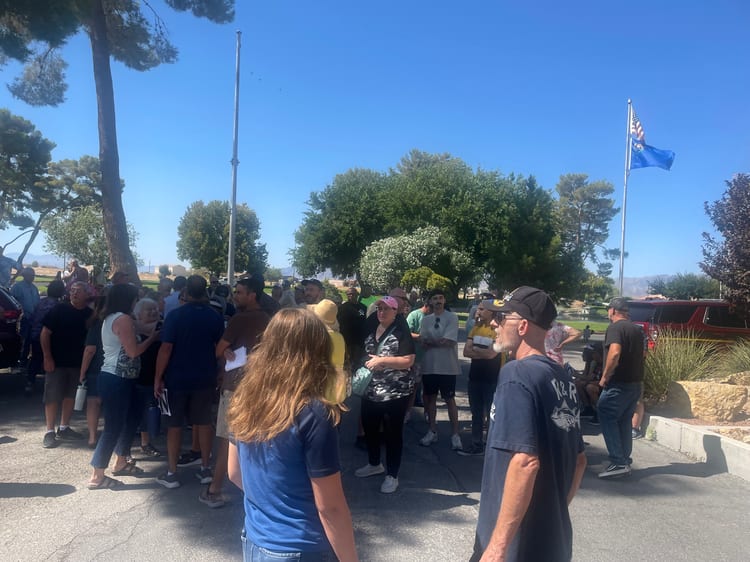
On the evening of August 11, at the Veterans Memorial Building on East Street, the Pahrump Public Lands Advisory Committee took up Item 8 and voted unanimously against recommending it. Nye County Bill No. 2026‑01, which would rewrite parts of Chapter 17.10 of the county land use code, drew not one vote in its favor. That chapter governs commercial solar, battery storage, transmission lines, substations and gen-tie connections.
PPLAC advises. The Board of County Commissioners decides. So the bill goes back to the Board on a future agenda, and it can come back amended, renumbered, or broken into smaller pieces.
Still, look at the shape of what happened. The only public body that has reviewed this bill rejected it without a dissenting vote. And the reason any of it reached a public meeting was a private resident who pushed to get it on an agenda, not a commissioner.
The clause
Bill 2026‑01 would have added a new defined term to Nye County Code:
"APPROVED ASSIGNEE: Means (a) any Person that directly or indirectly owns, is owned by or is under common ownership, controls, is controlled by, or is under common control with the Permit Holder; or (b) any mortgagee, lender, secured party, purchaser at foreclosure, or assignee or grantee of an assignment, collateral assignment, conveyance or transfer in lieu of foreclosure pursuant to a mortgage, deed of trust, security agreement or similar instrument."
Read that out loud at a county meeting in a town of forty thousand people. Collateral assignment. In lieu of foreclosure. Deed of trust, security agreement or similar instrument. That is not zoning vocabulary. It is the wording you find in project finance credit agreements, the paperwork a bank's lawyers put in front of a solar developer before releasing construction money.
It arrived with the whole family of terms that travels with it: Permit Holder, Change in Control, Cumulative Remedies, Financial Assurances, joint and several liability binding "heirs, successors in interest, and assigns."
Here is what makes that strange. The national survey of county solar regulation published by NREL, California's draft model solar ordinance guide, and the rural electric co-op association's own permitting whitepaper say nothing about permit transferability, assignment, lenders or foreclosure. None of them. It is simply not a feature of the model documents counties copy from. Some counties go the opposite way. Monroe County, Illinois requires a brand new special use application any time ownership or lease control changes hands.
So the clause is not local, not standard, and not something a planning office produces on its own. Somebody supplied it.
No requesting party is named anywhere in either version of the packet. No developer, no company, no law firm, no attorney. Twenty-five pages, two trips to the Board, and nothing on the page says where the language came from.
How it was built
Current law, Ordinance 611, says a solar permit passes to a new owner only "by application to the planning department and approval from the BOCC."
Bill 2026‑01 kept that sentence word for word. Anyone reading the packet would find the Board's approval right sitting exactly where it has always been, fully quotable, apparently untouched.
Then, in a different section, it added one line. A "transfer" means an assignment or change in control, "excluding Approved Assignees."
The approval requirement survives. It just stops applying to a bank. Repealing the Board's authority outright would have been obvious and would have drawn a fight. Narrowing the definition of the event that triggers that authority gets the same result for the same people, and a commissioner reading a packet the night before will not catch it. That takes skill. It is what you pay a firm for.
What else it would have done
Seven changes favored the permit holder. Three favored residents or cut both ways. One was housekeeping.
The big one, after Approved Assignee, is neighbor consent. Ordinance 611 requires a variance application to include "an executed agreement between the Applicant and all participating and non-participating private landowners affected" before the county may even consider it. Bill 2026‑01 struck that and replaced it with documents that "may include letters of support or opposition." A veto becomes a comment card.
The rest, briefly. The 25‑foot panel height cap becomes something that can be waived, which it never was before. A second height limit tying mid-tier solar to the host zoning district disappears. "Commencement" gets a definition for the first time, and pulling a building permit satisfies it, so a five-year clock can be stopped without breaking ground. Extensions stop being something the Board has to agree to and become a form the applicant files, with no cap on how many and no standard for granting them. The applicant no longer has to sign the application. And Section 17.10.080, the table setting out which of eighteen zoning districts allow this infrastructure and on what terms, is deleted with nothing put in its place.
On the other side: a new pre-development meeting with staff, a new duty on the applicant to actually run the noise test, and the ambient noise baseline study moved from the County Planning Department to a "neutral third-party consultant." The applicant paid for that study before and would pay for it still. A public agency gets swapped for a private one and the result is called neutral.
What it left alone
The bill was presented as cleanup, and Chapter 17.10 genuinely needs some. The adopted ordinance contains three consecutive paragraphs all titled "Allowed Variances" with conflicting terms, one of them pointing at a section number that does not exist in the chapter.
Bill 2026‑01 fixed some of that mess. Here is what it walked past.
The penalty for violating the chapter stays where it was, at $1,000 a day, as a criminal misdemeanor, and only after fourteen days written notice to someone who "knowingly continues" to violate. Against a project costing hundreds of millions, that is a rounding error.
And nothing in the chapter, before or after, restricts what the permitted infrastructure may serve. A special use permit authorizes a substation, a gen-tie, a battery yard. Neither version requires the applicant to disclose who takes the power, or to come back for an amendment if that changes.
That silence has local weight. The County Manager has said on the record that the coming data center ordinance would follow "the same approval process, the same review process, etcetera" as the solar regulations, meaning data centers would run through this framework. The county is meanwhile under a moratorium the Board itself worded to cover "any data center or anything associated with a data center." A bill turns up to loosen the framework, and declines to close the one gap that matters most to the people living around it.
The pattern
None of this needs a conspiracy, and calling it one is how people lose these fights.
The underlying need is real. Lenders will not treat a permit as collateral if it can die at foreclosure. But that is the developer's problem, and this would have written the developer's solution into public law.
It arrives labeled as cleanup, because technical corrections draw no crowd. It moves through definitions rather than procedures, so the protections stay on the page while the thing that triggers them quietly shrinks. And it routes around review.
Bill 2026‑01 never appeared on a Pahrump Regional Planning Commission agenda in April, May, June, July or August. On the August agenda, the Commission was scheduled to make a recommendation on TA‑43, an amendment about backyard chickens.
The Commission shows up twice in the bill, both times as the body that grants these waivers inside the Pahrump district. That is the only power it holds in the entire chapter. The bill would have widened that power by adding height to the list, while deleting the neighbor signature that made it safe to say no.
Before anyone reruns this
The headline protections were never at issue and remain law: 1,000 feet from a non-participating neighbor's property line, one mile from residentially zoned land inside the Pahrump district, half a mile from Highway 160, a 25‑foot height cap, decommissioning bonds at full estimated cost.
A few things being passed around as outrages about this bill are already law under Ordinance 611 and were not its doing. The "substantial hardship to the applicant" waiver test. The three public meetings. The quarter-mile mailed notice radius. Pahrump's exclusion from the town board letter requirement. Applicant funding of the noise study. Criticize all of it, because a quarter-mile notice radius really is smaller than the 1,000‑foot setback it can waive. Just criticize it as current law. Getting that wrong hands staff a one-sentence rebuttal and costs you everything else you said.
A unanimous advisory vote slows a bill. It does not stop one, and it does nothing to the language, which still exists and still came from somewhere.
Nevada's Public Records Act presumes government records are open, and correspondence about a proposed ordinance is a public record. Ask for any application or proposed language submitted from outside county government, all correspondence between planning staff or the District Attorney's office and outside parties about Chapter 17.10, and all drafts in native electronic format, which keeps the authorship data that scanning strips out. The county has five business days to answer. Meeting video is archived at nyecounty.granicus.com, and staff often states on the record who asked for an ordinance.
Four questions that deserve answers out loud:
- Who requested Bill 2026‑01, and was any of its language drafted outside Nye County government?
- What county interest is served by letting a permit pass to a foreclosing lender without Board review of the new holder?
- Does anything in Chapter 17.10 limit what a permitted substation, gen-tie or battery system may serve? If a permitted facility later served a data center, would that take a permit amendment?
- Why was a Title 17 amendment of this size never routed to the Pahrump Regional Planning Commission, when Title 17 amendments routinely are?
Sources. Nye County Ordinance No. 611 (Bill 2024‑03), adopted December 17, 2024, Document Center #48096, current law. Nye County Bill No. 2026‑01, Document Center #51492 (BOCC July 21, 2026, Item 8) and #51221 (June 16, 2026, Item 18). BOCC agendas June 2, June 16 and July 21, 2026. PRPC agendas April through August 2026. PPLAC agenda August 11, 2026. NREL, County Land-Use Regulations for Solar Energy, TP‑88556. California GO‑Biz draft Solar Model Ordinance Guide, October 2025. NRECA SUNDA permitting whitepaper. Monroe County, Illinois Code § 40‑4‑112(B).
All comparisons drawn from the clean text of both instruments. The tracked-changes copy in the county packet is a scan, and strikethrough and underline do not survive text extraction, which produces false readings in both directions.