APPEAL MEDIWASTE PERMIT HERE: https://sec.nv.gov/participate/sec-appeal-process/
We used the date Aug 26th, the date the permit was issued; for the 10 day appeal window to be on the side of caution so people can get their appeals in. NDEP put it online Aug 31.
Part of a continuing investigation into the MediWaste medical waste incinerator. There is more in this than fits in one story, so we are building it out a piece at a time.
The Nevada Division of Environmental Protection (NDEP) issued the MediWaste permit on August 26, posted online on Aug 31st.
The permit is number SW1900REV00. It says it took effect on August 26. You can read the whole permit and the letter that came with it.
The permit lets MediWaste run seven incinerator units, which it calls pyrolysis units, at 1850 East Basin Avenue. That is the next block over from the county government complex, and it is a stone's throw from the Pahrump DMV.
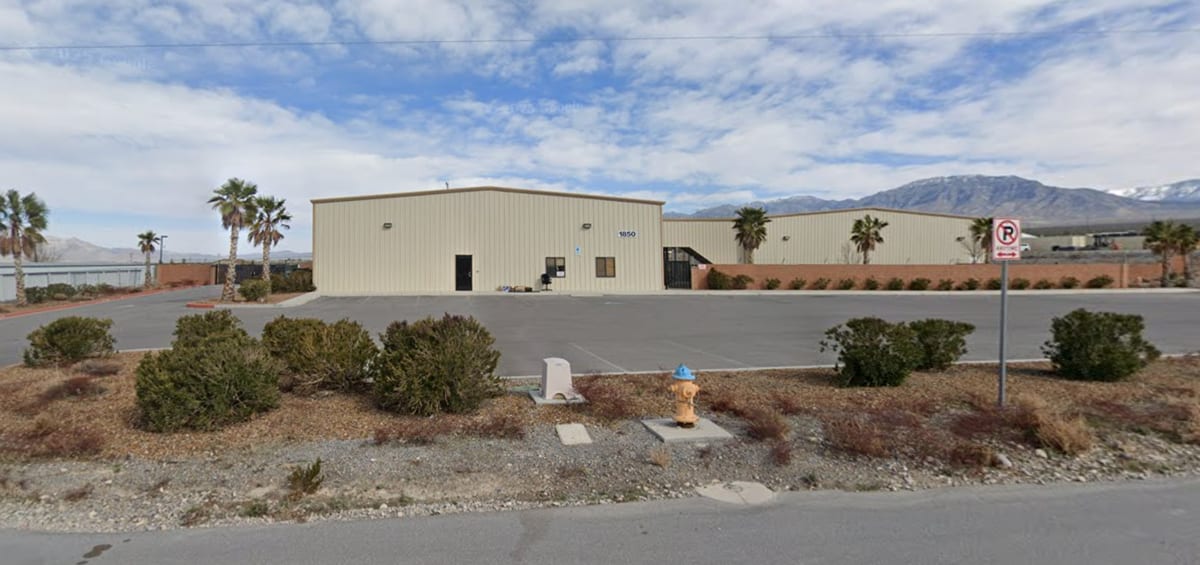
That is it. Two metal buildings that are already standing. The permit does not have MediWaste changing either one. Building 1 is 8,650 square feet and takes the waste in. Building 2 is 3,764 square feet and holds all seven pyrolysis units. Google Street View.
Here is how the permit itself describes the neighbors:
Immediately adjacent to the West of facility is a storage facility. Immediately West of the storage facility is an urban center which holds the Pahrump DMV and a local Church. To the east of the facility is an existing ready mix concrete supplier site.
The site is about seven tenths of a mile east of Highway 160. The permit calls the process pyrolysis. The word matters, and we come back to it below. What is left over is called hydrated ash.
That term does a lot of work, and the permit never defines it. We take it apart in the next part of this series.
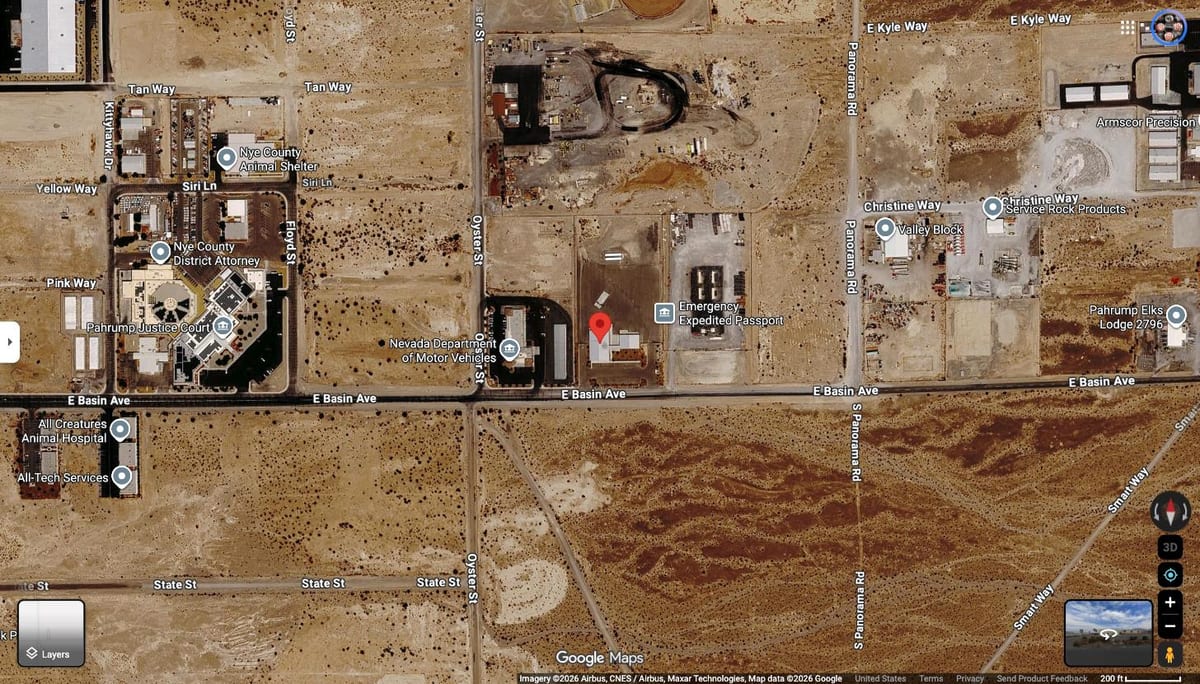
The pin is the site. The building west of it, at Oyster Street, is the DMV. One block further west is the county government complex. The Pahrump Justice Court and the District Attorney's office are both at 1520 East Basin Avenue. The plant is at 1850. Same street, 330 numbers apart.
The numbers are in the permit itself. 41.4 tons of medical waste a day. 15,120 tons a year. Up to 450 tons of untreated waste on the property at one time. That is 250 tons inside Building 1, plus 200 tons in sealed trailers on the paved lot.
The waste comes from Nevada, from California, and from what the permit calls "other various markets throughout North America."
People did speak up
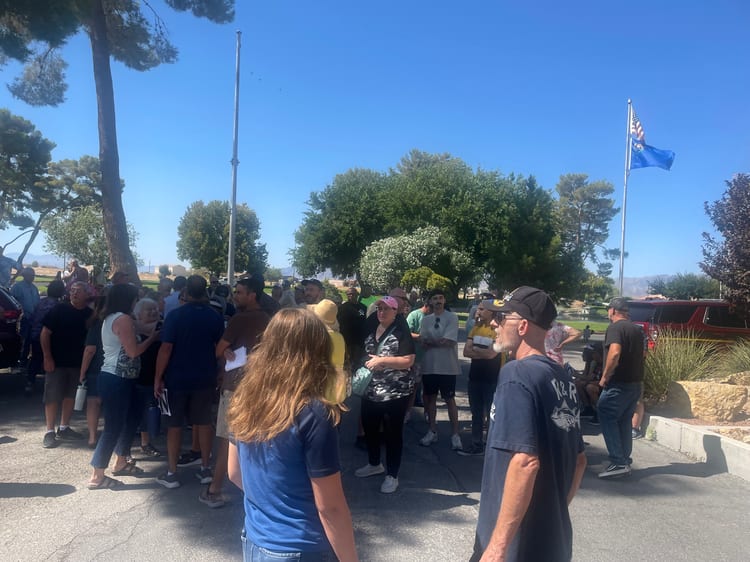
The comment period ran from April 1 to May 1. The state received 334 comments. Thirteen people asked for a public hearing. The state held one on July 7 at the Nevada Treasure RV Resort, and the recording and transcript are in the state's file, and the Pahrump Valley Times counted more than 100 people there.
The Nye County Water District filed a formal protest on April 14. Its own minutes show how that went. It was Item 16, at 1:24:55 on the tape. Board member Helene Williams moved to send the protest letter, but only after "removing Items #2 and #3 from the body of the letter." Michael Lach seconded. It passed 4 to 1, with Bruce Holden voting no.
So the district that sits on top of Basin 162 did protest, and it trimmed two of its own complaints out of the letter before it went. You can check all three: the agenda, the minutes with our copy, and the video. The Pahrump Valley Times covered the meeting.
Here is what the state wrote back, in its response to all 334 comments:
Submissions expressing general opposition without identifying a specific deficiency in the draft permit or a requirement of NRS/NAC Chapter 444 that the application fails to meet are recorded as part of the public comment record and considered; a general expression of opposition does not itself establish a basis to deny the permit.
That sentence is the whole thing. Nevada's solid waste rules do not count people. They ask one question: does the application meet NAC 444.6425 and the rest of Chapter 444. That is two books, and both are online: the statute is NRS Chapter 444, the regulation that fills it in is NAC Chapter 444. The Division decided the application meets them.
Why we call it an incinerator
The permit does not use that word. It says pyrolysis. We use the other word, and here is the document behind it.
Federal rules define pyrolysis narrowly. Under 40 CFR 60.51c it means the "endothermic gasification of hospital waste."
Endothermic means the process takes heat in rather than giving heat off. A system that is not endothermic all the way through is not a pyrolysis unit under that rule. It is an incinerator.
In 2019 the EPA was asked that exact question about a plasma assisted pyrolytic system called CoronaLux. The answer is control number 1500085, published in the Federal Register on March 18, 2019. We keep our own copy. Both answers are short.
Q1: Does EPA determine that the exemption at 40 CFR 60.50c(f) for "any pyrolysis unit" applies to the CoronaLux plasma assisted pyrolytic system to be installed at the eCycling International, LLC facility located in Ulmer, South Carolina?
>
A1: No. The exemption at 40 CFR 60.50c(f) does not apply to the CoronaLux system because the definition of "pyrolysis" at 40 CFR 60.51c is the "endothermic gasification of hospital waste . . ." and the CoronaLux system is not endothermic throughout the system.
Q2: Does EPA determine that the CoronaLux system would be subject to 40 CFR part 60 subpart Ec (hospital/medical/infectious waste incinerator (HMIWI) standards)?
>
A2: Yes. The CoronaLux system, if constructed and operated as described, is a HMIWI, as defined in 40 CFR 60.51c.
Now read how Nevada's own fact sheet describes the machine going in on East Basin Avenue. Three stages. First a primary pyrolytic chamber. Then this:
The vapors are then received by the second stage where a plasma forms.
And then this:
Following this point in the process, excess air is quantitatively introduced to begin the oxidation process converting the VOCs to carbon dioxide and water vapor.
Air, added on purpose, to oxidize. That is burning, and it is the state's own sentence in the state's own fact sheet.
NDEP's stated reason for calling it pyrolysis is one line: "the primary treatment occurs through endothermic gasification in the absence of oxygen." Read it again. Primary. The EPA's whole point in 1500085 was that the test has to hold across the whole system, not just the first chamber.
One more thing sits in the file. Attachment 1 to the permit is the "Vulcan Medical Waste Treatment Facility Application v6.0," and NDEP copied its permit letter to "Fortunato Villamagna, Vulcan Systems, Inc." Villamagna founded Paragon Waste Solutions, the company behind CoronaLux, and holds patents on its emission control.
Here is what we cannot tell you. No document we have says MediWaste's seven units are CoronaLux units. The process description matches, the name on the application matches, the man on the distribution list matches. The model name is written down nowhere we can see. We have asked MediWaste and NDEP and we will print whatever they send.
The comments did change the permit
This part is real, and it belongs in the same story.
- Waste can now sit on site for 15 days, not 30. The state cut it in half after people wrote in about summer heat in Pahrump.
- Reports to the state are quarterly now, not once a year.
- Embryos were added to the banned list, using the definition in NRS 451.015.
- Dioxins and furans in the ash got a hard number: 20 nanograms of toxic equivalent per kilogram, dry weight. We explain that number, and what it adds up to over a year, in the next part.
- Every floor drain in the building has to be sealed shut, with proof sent to the state, before the doors open.
- The emergency plan, the fire suppression plan and the 24 hour hazmat plan all have to go to Pahrump Valley Fire-Rescue.
- Money for cleanup has to be approved before it opens, under NAC 444.6851.
Those are seven things residents got by writing letters. None of them would have happened on their own.
If you want to appeal the state permit, the date is September 5
Appeals go to the State Environmental Commission, not to NDEP and not to the county. It is a seven member state board, and it is the body that hears appeals of NDEP decisions. The rule is NAC 445B.890.
The paperwork is one form, and it is free. Form 3, "Request for an Appeal Hearing," is two pages: a page of instructions and a page of blanks. It is not special to MediWaste. It is the form the Commission uses for every appeal of an NDEP decision. Get it straight from the Commission, or use our copy. We downloaded both and they are the same file, byte for byte. It sits on the Commission's forms page as "Form #3 - Appeals."
The deadline. Two separate Commission pages say the same thing. The forms page: "you must submit this form within 10 days of NDEP's final decision or action." The appeal process page: appeals must be "received timely, within 10 days after the date of a final decision." The permit says it took effect August 26. Ten days after August 26 is September 5
NDEP's letter also prints the date September 10. Those two do not match, and we cannot tell you which one a hearing officer would honor. Treat September 5 as your deadline. Being early costs you nothing. Being late ends it.
The form asks you to pick your grounds from five choices. The decision broke a law or the constitution. The decision used an unlawful procedure. The decision got the law wrong some other way. The decision was clearly wrong given the evidence in the record. Or the decision was arbitrary, capricious, or an abuse of discretion.
Then it asks you to name the statute or regulation, and to state the facts. Attach a copy of the permit, which you can download here. Mail it to the Executive Secretary, State Environmental Commission. The address is 901 South Stewart Street, Suite 4001, Carson City, NV 89701. The Commission's phone is 775-687-9374 and the contact listed on its own forms page is sfontaine@ndep.nv.gov. If you are close to the date, call first.
Who to call
The state, on the solid waste permit. Jonathan Zittel, Permitting Branch Supervisor, signed the notice. Annalyn Settelmeyer, Chief of the Bureau of Sustainable Materials Management, signed the permit. The bureau's line is 775-687-9462 and its email is solidwaste@ndep.nv.gov. Contacts are on NDEP's site.
The state, on the air permit. That is a different bureau, with its own contact page.
The company. MediWaste Disposal LLC. Ryan Oganesian is listed as President on the state's letter, at ryan@medi-waste.com. The general line is 855-449-6334 and the general email is info@medi-waste.com. Corporate headquarters is 235 Deininger Circle, Corona, California. Mail goes to P.O. Box 6579, Corona, CA 92878. Their site is medi-waste.com.
The county. All five commissioners were copied on the state's letter: Bruce Jabbour, Ian Bayne, Debra Strickland, John Koenig and Ron Boskovich, along with County Manager Brett Waggoner. Their phone numbers and email addresses are here. Their contacts are on the Board's own page.
The record. The full administrative file, including the hearing recording and transcript, is at ndep-onbase.nv.gov. The facility's row is on NDEP's solid waste facilities list.
What we have not done
We have not asked MediWaste for comment on this story. We have not asked NDEP which of the two dates in its own letter controls. We have not confirmed whether MediWaste holds a Nevada business registration. The Secretary of State's search blocks automated tools, and we have not opened it by hand. The permit itself requires that registration before the doors open, so it is a fair question for anybody with a browser and five minutes.
Here is the search, click it and look: Nevada Secretary of State business entity search. Type MediWaste Disposal into the entity name box. It will tell you whether the company is registered in Nevada, when it registered, whether it is in good standing, and who its registered agent is. The Secretary of State's own page is the front door if that link ever moves.
What we have done is read the four documents the state sent out and put copies of all of them on this page, so you do not have to take our word for any of it.
If MediWaste, NDEP or the county wants to answer, send it through our contact form and we will print it in full, unedited.
There is so much going on here that we are building it in parts
We have the signed permit, the fact sheet, the state's written answers to 334 comments, three documents from a separate air permit, the Pahrump landfill's permit, the water district's minutes and Nye County's own code. That is a stack, and there is more than one story in it. Rather than bury you in a very long article, we are building this out a piece at a time and putting every document on this site as we go.
Two threads we are already pulling:
- What the ash actually is, and how much of it there is. The permit calls it "hydrated ash" and never defines the term. It does set a limit for dioxins and furans in that ash. We worked out what that limit adds up to across a year, and how many semi trucks move through the gate.
- Who else has a say. NDEP answered 21 topics in its response to comments. On most of what people wrote in about, the answer was that the matter belongs to somebody else. Air is a different bureau. Zoning is the county. And Nye County has its own law on handling hazardous material, passed in December 2024, with a pause on it that ran out on July 1 of this year.
If you want to be told when the next one goes up, our contact form is the place to say so. If you have something we should see, that form is also how to send it. Permits, letters, photographs, a bill of lading. We will tell you what we can check and what we cannot.
The documents
Ours, so the links cannot rot:
- The signed permit, SW1900REV00
- The Notice of Permit Issuance
- The Division's responses to all 334 comments
- The fact sheet
- State Environmental Commission Form 3, the appeal form
- Nye County Water District minutes, April 14, 2026, Item 16, the protest letter vote
- Nye County Code Chapter 8.44 in full, all seven sections, verbatim
- Air permit AP4953-4771: the Class II operating permit, the Director's Review, the proposed action
- Pahrump landfill permit SW0097
- The draft solid waste permit as published April 1, 2026, for comparing against the signed one
The state's own copies:
- NDEP, solid waste facilities list and the administrative record
- NDEP Bureau of Air Pollution Control, permit AP4953-4771: proposed action, Director's Review, Class II operating permit
- Nye County, Board of County Commissioners, Public Works and agendas and minutes
- Nye County Water District, its Governing Board, April 14, 2026 agenda, minutes and video
- State Environmental Commission, Form 3 and the appeal process
- Nye County Code, Chapter 8.44, adopted by Ordinance 613 on December 17, 2024 and amended by Ordinance 622 on January 21, 2026
The law:
- NAC 444.6425, issuance and denial of a solid waste permit
- NAC 444.676, system to process waste, other methods
- NAC 444.6851, financial assurance for closure
- NAC 445B.890, appeals to the State Environmental Commission
- NRS Chapter 444 and NAC Chapter 444, Nevada's solid waste law in full
- NRS 444.580, local rules may be stricter than the state's
- NRS 451.015, definition of embryo
Look it up yourself:
- Nevada Secretary of State business entity search
- Nye County Board of County Commissioners staff directory
- Nye County Water District Governing Board
- NDEP Bureau of Sustainable Materials Management contacts
- NDEP Bureau of Air Pollution Control contacts
- State Environmental Commission forms
Background:
- US EPA, Learn about Dioxin
- World Health Organization, Dioxins and their effects on human health