An acre-foot covers a football field about nine inches deep. Stack 192.77 of them and you get a column of water on that field about 146 feet tall, roughly a fourteen story building. Every year.
That is the figure Double M Construction brought to the Nye County Water District on August 6. But a yearly total is an average, and averages are smooth. Take the campus apart using the company's own descriptions, and several large uses turn out to be missing, buried, or unexplained.
Fill it, flush it, do it again
At the meeting, Russ Meads of Double M said the cooling system holds about one third of an acre-foot, mixed with chemicals that stop freezing and mineral buildup. That is about 109,000 gallons, roughly six backyard pools inside the pipes of one station. The campus is four data centers built in five phases, so filling all four takes about 434,000 gallons before a single server switches on.
Then it has to come out. Cooling water picks up minerals, Pahrump groundwater is hard, and hot equipment builds scale fast. A flush means drain, rinse, refill, taking two to three times what the system holds, so flushing all four stations once runs 870,000 to 1.3 million gallons. How often? Coverage reported five to ten years. Residents in the room understood closer to a year and a half. At the shorter interval, with four stations staggered so the campus never shuts down, a system is being drained and refilled somewhere out there every few months, permanently.
Here is what matters most. The used water is trucked to US Ecology near Beatty, a regulated hazardous waste facility. It does not evaporate over Pahrump, does not soak back into the ground, and never comes back. Nothing in the 192.77 figure says whether it is counted.
The desert takes water in both seasons
Most people assume the water problem is summer. There is a winter one too.
Computers hate dry air, because static builds up and damages equipment. Operators hold humidity around 40 to 50 percent, and Pahrump air is far drier than that most of the year. So the building has to add moisture, and the only way to do that is evaporate water into the air, where it is gone. Manse's own water page budgets for "humidification," which sits badly beside the company's other claim, that water is "recycled continuously rather than being evaporated or discharged." You cannot recycle water you deliberately evaporated.
Summer is worse, for a reason most people find backwards. Air-cooled equipment weakens as air heats, losing 10 to 30 percent of its power at 110 to 115 degrees, right when it is needed most. The standard fix is spraying a fine mist into the incoming air. Misting works best in dry air, which means it drinks the most in dry air.
Vertiv, which builds this equipment, publishes both numbers. Without misting, essentially zero water. With misting, about 4.4 acre-feet per megawatt every year. Same brochure, two very different water bills, and Manse has never said which one it is building.
The workers who use more than your whole house
One more line deserves a look.
The packet sets aside 62,863 gallons a day of drinking and restroom water for 380 employees. That is 165 gallons per person, per day, where real office buildings measure about 13. Put it beside your own house. The EPA says the average American family uses more than 300 gallons a day at home, everyone in the household, around the clock. Two Manse employees are allotted more water than that entire family, for an eight hour shift, after which they drive home and use water there too.
Your house gives most of it back. A home on a well and septic returns 55 to 76 percent of what it pumps, straight into the ground underneath. This water returns nothing. So a figure that already looks too big is worse than it looks.
The line nobody explained
The biggest single item in the whole presentation is one line reading 122.36 acre-feet of non-potable water, with a note beside it saying "this should cut by 50%." No breakdown, no source, and it is 63 percent of the entire figure.
That works out to about 109,000 gallons every single day, which is the same amount Mr. Meads said it takes to completely fill one cooling station. So a sealed loop that supposedly recycles its own water is budgeting enough every day to fill itself from empty again. Over a year that is nearly 40 million gallons, or the yearly use of 245 Pahrump households.
The water you cannot see, at the other end of the wire
Manse says it plans to buy its electricity from Valley Electric Association. VEA owns no power plants. It says plainly that it "buys power from the open market" and that "a percentage of our power comes from hydro-dams along the Colorado river."
The electricity comes in on a wire from somewhere else, and making electricity takes water. Power plants boil water to spin turbines, then use more to cool it down, and a great deal of it evaporates. Federal researchers put the cost at roughly half a gallon to two gallons of water for every kilowatt-hour, depending on how the power is made. Hydropower is thirstiest of all, because a reservoir sitting in desert sun loses a staggering amount to the air. So part of VEA's power is made by water evaporating off Lake Mead, in a river already in shortage.
For a campus in the 450 to 1,200 megawatt range, the electricity alone accounts for roughly 2,900 to 13,600 acre-feet a year. Basin 162 has about 6,500 left.
That water doesn’t come from a Pahrump well, and that is the point. A building that uses little water on site does it by using far more electricity, and that electricity is made with water somewhere else. The water does not disappear. It moves somewhere nobody here gets a vote on.
The problems with water mining, and why nobody can put it back
Farms return about 48 percent of what they pump. Homes return 55 to 76. Water hauled to Beatty returns zero. One acre-foot trucked out of this valley drains the aquifer about as much as two to four acre-feet pumped by a household. That is the textbook definition of groundwater mining. Comparing gallons to gallons, as the presentation did, hides that completely.
The basin cannot spare it. Basin 162 refills at about 20,000 acre-feet a year from Spring Mountains snow, while rights already promised on paper total 74,776 acre-feet, more than three times that. About 6,500 acre-feet of room is left, and water below that line collected underground over thousands of years.
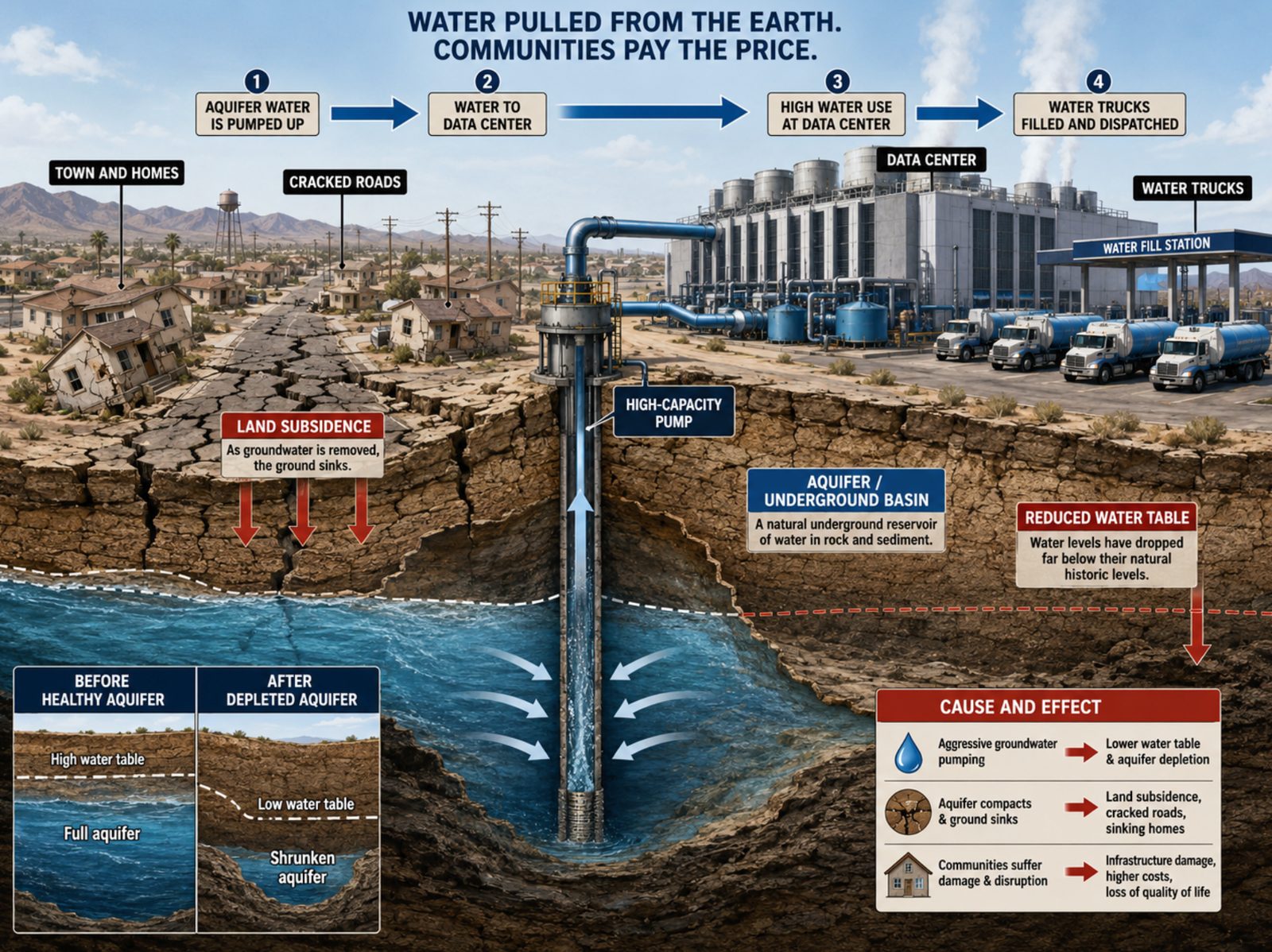
Here is the part that should worry people. When you pump an aquifer faster than it refills, you are not just emptying a tank. The water was holding open microscopic spaces between grains of clay and silt. Take it out and the weight of everything above presses those spaces shut.
The U.S. Geological Survey is blunt about what happens next. Compaction causes "a permanent reduction in the total storage capacity of the aquifer system." Permanent. The pore spaces do not spring back, and more than 80 percent of land subsidence in this country comes from pumping groundwater.
Understand what that means here. If every pump in this valley stopped tomorrow, and it snowed hard every winter for a century, the aquifer would still never hold what it once held. The tank is not being drained. It is being crushed, a little more each year, and the crushed part is gone for good.
The Desert Research Institute found the water table under Pahrump dropped about 25 feet between 1999 and 2017, with subsidence recorded since the 1960s: cracked foundations and slabs, fissures opening in the ground, well casings sheared off, and extensive damage to roadbeds.
You can drive out and see how this ends
You do not have to take anyone's word for it. Both of these are a day trip.
Owens Valley and Owens Lake, California. A few hours west through Death Valley. Los Angeles began diverting the Owens River in 1913 and by 1926 the lake was dry. What is left is 110 square miles of bare lakebed throwing off as much as four million tons of dust a year. As recently as 2013 it was the largest single source of dust pollution in the United States, a problem serious enough that the National Academies still study it. That dust carries arsenic, cadmium and nickel and pushes air quality past federal limits more than 50 miles away. Los Angeles now floods 27 square miles of it just to hold the dust down, spending water to fix what taking water caused.
Ash Meadows and Devils Hole, right here in Nye County. Under an hour from Pahrump. In the 1960s and 70s, irrigation pumping in the Amargosa Valley pulled down the water level in Devils Hole, a flooded cavern holding the only Devils Hole pupfish on Earth. It reached the U.S. Supreme Court, which ruled in 1976 in Cappaert v. United States that the government could limit a nearby ranch's pumping to protect that water level. It happened in this county, over this same aquifer, and settled a simple point: pumping in one place lowers water in another.
Closer than either, it is already under your own house. Pahrump homeowners know part of this by another name: "poof dirt," powder-fine soil that shifts and sinks. A local investigation found up to 100 homes affected in one part of town, with cracked patios, sliding fences, and foundations that sank so badly the homes were abandoned. In 2013 a sinkhole three and a half feet across opened in the yard of a Nye County Water District board member, and the state's chief of hydrology said falling water levels can "create subsidence in areas with hydro collapsible soils."
Then it reaches your lungs. Dry, disturbed desert soil goes airborne as PM10, particles small enough to get deep into the lungs and cause real breathing problems. Owens Lake is the extreme version of what a dried-out basin floor does to a region's air. Pahrump is not Owens Lake. But the mechanism that built Owens Lake is already working here, and the only difference is how much more water comes out.
We are being asked to decide before the study is finished
Here is the most uncomfortable fact in this story.
Nobody actually knows how much water Basin 162 gets back each year. The official figure is 20,000 acre-feet, but that is an estimate, not a measurement. Nobody meters snowmelt soaking into the ground, and published figures have run from 12,000 to 26,000. The most important number in this valley's future is a range we have treated as a fact for decades.
The Water District knows it. That is why it is spending $300,000 right now, mostly federal money, working with the Desert Research Institute on a model that can forecast what new development does to this aquifer. That work is due September 30, 2026.
The largest water decision in this valley's history is being made in the same season the tool built to evaluate it is still being finished. And it cannot even be run on this project, because the capacity every water figure depends on has never been disclosed.
Water mining has been studied enough to know it is permanent. It has not been studied nearly enough here, at this scale, to know how much more this valley can take before something breaks that cannot be fixed.
The one question that unlocks all of it
A data center's water use is calculated from its electricity use. Manse has never said how much power the campus will use. Not in the presentation, not on its website, not to reporters, not at the meeting.
Yet the water figures are given to the hundredth of an acre-foot, about 33,000 gallons of precision. You do not get that from a guess, so either a power figure was used and not shared, or none was used and the decimals are decoration.
Using the company's own published investment and staffing numbers, outside estimates land between 400 and 2,500 megawatts. At the Desert Research Institute's middle estimate for Nevada, a campus in that range would use 1,783 to 3,567 acre-feet a year, or 27 to 55 percent of everything this basin has left. Or a small fraction of that, if they build the dry system they describe.
The gap between those two futures is the whole argument, and it comes down to one number anyone could supply in a sentence.
Ask for it before the ground answers for us.
Figures come from the Double M Construction presentation to the Nye County Water District on August 6, 2026, the Manse Technology Campus website, the Pahrump Basin 162 Groundwater Management Plan, the Desert Research Institute, the U.S. Geological Survey, Valley Electric Association, and published benchmarks from Vertiv, NREL and the EPA. Statements attributed to Mr. Meads come from that meeting and news coverage of it; the board's official minutes govern. No estimate of this campus's actual water use is offered here, because the number needed to calculate one has not been made public.