On 6 May the Nye County commissioners approved the county's capital plan for 2026-27. The vote was 5-0, moved by Commissioner Bayne and seconded by Commissioner Strickland. The minutes record it as "prioritized and approved."
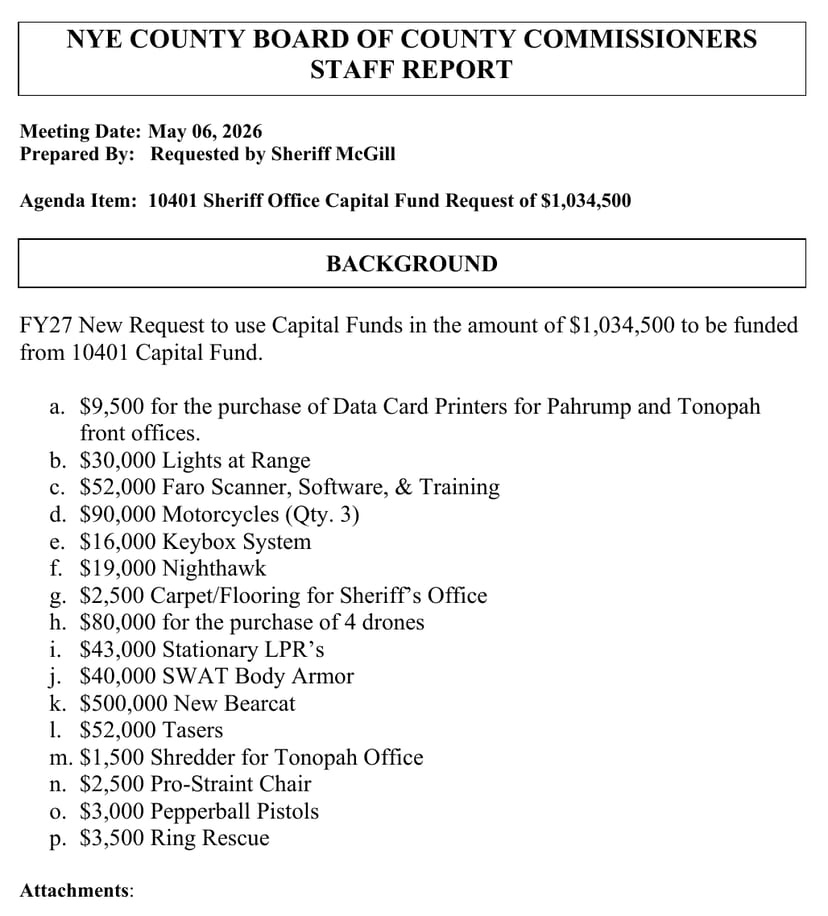
Inside that plan, under the Sheriff's Office, is a line reading Nighthawk, $19,000.
NightHawk is not a vehicle or a radio. It is the software that makes other surveillance equipment add up.
What it does
NightHawk is sold by LeadsOnline, a Texas company that bought Nighthawk.Cloud, Inc. in May 2024 and is backed by the private equity firm TA Associates.
The company's own description of what it ingests is worth reading slowly. Its list: "Call Detail Records (CDRs), text messages and messaging app data, social media activity and metadata, ALPR hits and vehicle tracker data, gunshot detection and acoustic alerts, GPS trails and ankle monitor pings, device extractions and forensic artifacts, app usage, user accounts, and identifiers."
It fuses those, the company says, into "one synchronized map and timeline, ready to analyze in minutes, not days." A separate feature it calls Collaboration Without Boundaries lets an agency "securely share cases, maps, and findings with other units and agencies through CJIS-compliant cloud access."
That is the whole point of the product, and it is a real capability. A plate read tells you a car passed a spot. A phone extraction tells you who somebody talks to. Put them on the same timeline and you have where a person went, when, and who was moving with them.
The county's own description, given to the Pahrump Valley Times in April, is shorter: software that "compiles digital data from multiple sources into one platform, allowing investigators to analyze and establish evidence more efficiently." The Sheriff's Office credited it with a child exploitation case that ended in a guilty plea and a 35-year sentence.
Nothing on the LeadsOnline page mentions a warrant, a retention period, or an audit.
"If you are not doing anything wrong"
That is the honest first reaction of most people in this county, and it is not a stupid one. If you are not a criminal, why would you care what a camera sees on Highway 160?
Here is the answer, and none of it requires believing anyone at the Sheriff's Office is acting in bad faith.
It assumes the machine is right. In Roseville, California, the Institute for Justice found Flock cameras sent police 1,427 alerts over two years flagging cars as stolen or used in a felony. The plate was read incorrectly in 71 percent of them. A dirty plate, a tinted cover, a 7 that looks like a 2. You do not get a say in whether the camera reads your plate correctly.
Being wrongly flagged does not get you a ticket. IJ counts at least 27 cases since 2018, most of them since 2023, of innocent drivers pulled over, detained at gunpoint or jailed because of a plate reader error. In nearly two thirds, officers did not discover the mistake until after they had drawn their guns. In Sherwood, Arkansas in February, a couple were ordered out of their car at gunpoint over a misread plate while their six week old baby stayed in the back seat. In Toledo in April 2024, a driver was held at gunpoint, bitten by a police dog and jailed for several hours because a camera read a 7 as a 2.
Those people were not doing anything wrong. That was the problem.
It assumes the person searching is looking for a criminal. IJ has documented officers using plate reader systems to track romantic interests. That is the ordinary abuse, and in a county where everyone knows everyone it is the one worth thinking about hardest. Not a government conspiracy. A deputy with a login and a bad breakup.
It assumes "wrong" means the same thing everywhere. 404 Media reported more than 4,000 nationwide or statewide Flock searches by local and state police done for federal immigration purposes, and its reporting prompted a congressional investigation that included a Texas officer searching cameras across the country for a woman who had ended a pregnancy. Whatever you think about either subject, notice the mechanism: a camera in one state, a search from another, for conduct that is lawful where the driver was.
And you cannot check any of it. This is the part that should bother a small government conservative most. Nevada has no law requiring anyone to tell you a camera exists, no retention limit, no rule about who may be given access, and no warrant requirement. There is no form you can file to find out whether your truck is in the system, who searched for it, or why. "I have nothing to hide" is a reasonable thing to say about a system you can inspect. Nobody in Nevada can inspect this one.
None of that is an argument that the Sheriff's Office should not solve crimes. It is an argument that a tool this powerful should come with a published retention period, an audit log, and somebody outside the agency able to read it. Right now the state requires none of the three, so the only thing standing between the data and misuse is the good judgment of whoever holds the login.
Three tries
The county's 2026 meeting summary records every time NightHawk reached the Board.
6 January 2026, item 15. An amendment to the Pahrump public safety sales tax plan "to purchase NightHawk software in the amount of $18,780.20 for the purpose of data analysis and visualization platform for law enforcement use." The Board did not vote it down. It continued the item, in the summary's words, "until the District Attorney has time to research." Motion by Commissioner Strickland, seconded by Commissioner Koenig, 5-0. The agenda, minutes and video are public.
3 February 2026, item 13. The same software, the same fund, a new figure: $52,578.70. Nearly three times January's price, four weeks later. Attached to it was a second question, "determine the percentage breakdown for Pahrump's PSST funds and to determine other funding sources." The summary's entry for what happened is three words: *Removed from the agenda.* Again, the agenda, minutes and video are public.
Three other Sheriff's Office items were pulled the same day: FARO 3D scanners at up to $60,000, an $85,000 recreational vehicle for use as a mobile command post, and Tasers at not more than $350,000.
6 May 2026, item 11. NightHawk is in the capital improvement plan at $19,000, close to where it started in January. It is one line among eighteen for the Sheriff's Office in a plan covering every department in the county.
Here is the difference that matters. In January and February the software had its own agenda item, its own number, its own price and its own debate. In May it did not. The motion approved a capital plan. It never said the word NightHawk, and it did not have to.
Nobody has explained the February figure. No document we have found says what the District Attorney was asked to research in January, what he concluded, or whether that research is what moved the price. We have asked.
What else is in the same plan
Two lines below NightHawk, in the same approved document, under the same department:
- $43,000, "Stationary LPR's"
- $80,000, four drones
In law enforcement budgeting, LPR is license plate reader. That is our reading of an abbreviation in a budget table, and we say so plainly: we have not seen a specification, a vendor, or a quote for that $43,000. It is the one thing in this story we cannot yet show you a document for, and we have asked the Sheriff's Office to identify it.
If it is what it appears to be, then the county has approved the cameras and the software that fuses what the cameras see, in the same vote, on the same page.
The Sheriff's capital request is not mostly surveillance. The largest single line is $1,000,000 for vehicles, and the request totals $1,265,500 from the capital fund plus $172,500 from the public safety sales tax. Anyone reading this as a spending spree on spy equipment is reading it wrong. It is a fleet request with three surveillance lines in it.
One note on the arithmetic, because the county caught it first. A summary table in the same document totals the Sheriff's request at $1,034,500, and a handwritten note beside it says that figure "is incorrect," because motorcycles were counted twice and three small items were left out. We used the corrected numbers.
What Pahrump already has
Six Flock automated license plate readers are mapped in Pahrump. Four sit around the Home Depot on Highway 160 and name the store as their operator. Two more, near the old Gold Town casino, name nobody.
The Sheriff's Office has run plate readers for a long time. EFF's Atlas of Surveillance records the office buying two from PIPS Technology in 2010 for $37,400.
Nothing in the May capital plan is evidence about who operates the two unclaimed cameras. A budget line for future readers and an existing camera on a pole are different things, and we are not going to join them for you.
What Nevada says
Nothing, still.
The Nevada Independent reported in March that the state has no statute governing automated plate readers, and that "a search of legislation doesn't turn up any bills discussing the issue in 2025." Sixteen states have passed something. Nevada has not.
So there is no state rule on how long a plate read may be kept, who may be given access to it, whether the public has to be told a camera exists, or whether a warrant is needed to search where a car has been. There is likewise no state rule about combining that data with phone records and social media on one screen.
What we do not know
- Whether the money has been spent. A capital plan is a plan. Approval to budget is not a purchase order, and we have seen no contract with LeadsOnline.
- What "Stationary LPR's" specifies. See above. It is a budget line and nothing more until somebody shows us the rest.
- Where else NightHawk was approved. The Sheriff's 2027 public safety sales tax plan was adopted on 7 April, and the Pahrump Valley Times reported the software among approved purchases three days later. We have not obtained that plan's attachment, so there may be an approval we have not seen.
- What the District Attorney researched. The January continuance is the only public hint that anyone had a question about this software, and no answer to it has surfaced.
Four questions
- What did the District Attorney examine after 6 January, and what did he conclude?
- Why was NightHawk $18,780.20 in January and $52,578.70 in February?
- What equipment does the $43,000 "Stationary LPR's" line buy, from which vendor, and where would the cameras go?
- Does the Sheriff's Office intend to load plate reader data, its own or another agency's, into NightHawk? Under what retention period, and who else could search it?
If you know something about this, tell us.
Sources
- Nye County FY2026-27 Capital Improvement Plan, item 11, Board of County Commissioners, 6 May 2026
- Nye County 2026 Board of County Commissioners meeting summary, which records the January and February items and their outcomes
- Board agendas, minutes and video for 6 January, 3 February and 6 May 2026. Every meeting we index is at /meetings
- LeadsOnline's own description of NightHawk, and the announcement of its acquisition of Nighthawk.Cloud, Inc.
- Pahrump Valley Times, Nye County Sheriff's Office announces new equipment and technology purchases, 10 April 2026
- The Electronic Frontier Foundation's Atlas of Surveillance entry for the Nye County Sheriff's Office
- The Institute for Justice's database of plate reader abuse and its review of innocent motorists detained because of camera errors
- 404 Media, ICE Taps into Nationwide AI-Enabled Camera Network, Data Shows and Congress Launches Investigation into Flock
- The Nevada Independent, License plate reader cameras abound in Nevada. The state has no laws to regulate them
- Our own reporting on the six Flock cameras mapped in Pahrump